IT hardware refresh planning is one of the most underused recurring revenue opportunities for Dubai IT companies. Many clients wait until laptops fail, firewalls go end of life, WiFi becomes unstable, or server storage fills up. A managed IT provider can turn that reactive cycle into a predictable lifecycle plan.
Hardware that should be reviewed annually
- Laptops and desktops older than three to five years.
- Firewalls nearing subscription or support expiry.
- Switches with limited PoE, old firmware, or port failures.
- Access points that cannot support current density or security standards.
- Servers, NAS devices, backup appliances, disks, RAID controllers, and UPS batteries.
- CCTV recorders, access control controllers, label printers, and warehouse devices.
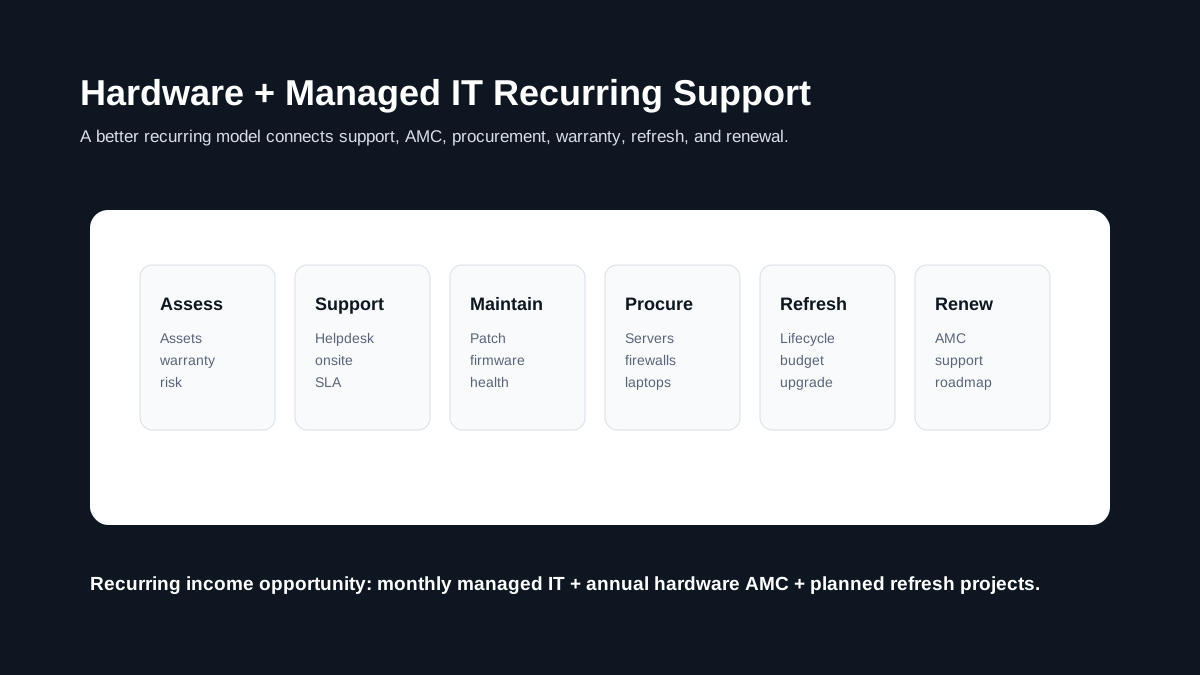
How this supports managed IT revenue
A refresh plan creates legitimate recurring income because the provider is not waiting for failures. The client receives asset visibility, budget planning, warranty tracking, and fewer emergency purchases. The provider receives AMC renewals, managed IT retention, deployment projects, and procurement opportunities tied to documented risk.
How Kaizen Star can use this content
Every managed IT assessment should flag end-of-life hardware and produce a 6, 12, and 24-month replacement view. This creates natural internal links to IT AMC, server maintenance, firewall support, WiFi solutions, backup disaster recovery, and office network setup pages.
Recurring revenue and customer value strategy
The commercial goal of this page is not only to rank for a single keyword. It should help Kaizen Star convert one-time IT enquiries into recurring support relationships. In the managed IT market, the strongest revenue model combines monthly helpdesk, monitoring, Microsoft 365 support, endpoint security, backup checks, onsite escalation, annual hardware AMC, and planned refresh projects. The client receives a predictable support partner; Kaizen Star receives a more stable account relationship that can renew, expand, and produce project work from documented need.
This is especially important for hardware-led opportunities. Hardware sales alone can become irregular and price-sensitive. Hardware support connected to managed IT is more defensible because the recommendation comes from asset records, ticket history, monitoring alerts, warranty expiry, security exposure, downtime risk, and replacement planning. A firewall replacement, switch upgrade, laptop refresh, UPS battery replacement, NAS expansion, or server migration is easier to approve when it is connected to uptime, security, backup, or staff productivity.
The offer should therefore be packaged as an operating model: assess the environment, put support under SLA, monitor critical systems, maintain hardware, report every month, and create a 90-day improvement plan. That model gives the buyer clarity and gives Kaizen Star recurring income from support rather than relying only on urgent repairs or one-off hardware quotations.
Keyword opportunities this page supports
This page supports a cluster of buyer-intent keywords that can be used in headings, internal anchors, image alt text, FAQs, and related content without using hidden keyword tags. The most relevant themes are managed IT services Dubai, managed IT services UAE, IT AMC Dubai, IT hardware AMC Dubai, 24/7 IT support Dubai, managed IT SLA Dubai, remote IT monitoring UAE, Microsoft 365 support Dubai, backup monitoring UAE, firewall management Dubai, endpoint management Dubai, server maintenance contract Dubai, network hardware support Dubai, laptop AMC Dubai, hardware refresh planning Dubai, and managed IT cost Dubai.
The search pattern is clear from the competitor research. Strong pages combine service breadth with commercial clarity. They cover helpdesk, network security, ticket handling, disaster recovery, remote monitoring, cloud services, email security, server management, infrastructure management, remote managed services, technical support, pricing, 24/7 support, SLA, industries served, and what is included. Kaizen Star should keep these terms visible in natural language because they describe the actual service model, not because they are keywords to be repeated mechanically.
The internal linking plan should use descriptive anchors. Link to managed IT services Dubai when the context is the main local service. Link to IT AMC services UAE when the context is physical maintenance. Link to firewall solutions Dubai for perimeter security. Link to backup and disaster recovery UAE for continuity. Link to Microsoft 365 Dubai for cloud productivity. Link to endpoint security UAE for device protection. Link to the top-10 comparison page when the user is evaluating providers.
Image SEO and visual assets
Managed IT is abstract, so visuals help both users and search engines understand the offer. Kaizen Star should use a mix of real infrastructure photos and generated infographics. Unsplash research showed strong visual categories for network rack, server rack, server room, data center, network operations center, and IT infrastructure. These topics are relevant for managed IT pages because they visually represent hardware, monitoring, cloud infrastructure, and data protection. When a suitable local project photo exists, that should be preferred over generic stock photography because it adds authenticity.
The generated SVG graphics on this page are intentionally descriptive: managed IT SLA workflow, managed IT ROI savings, and hardware recurring support lifecycle. Each file has a meaningful filename and each image tag uses alt text that describes the business concept, not just the graphic. This supports image SEO while keeping page load light. Future photo additions should use filenames such as dubai-managed-it-server-rack.jpg, it-hardware-amc-firewall-switch-dubai.jpg, microsoft-365-helpdesk-dubai-office.jpg, and warehouse-wifi-managed-it-support-uae.jpg.
Every image should have a specific purpose. A server rack photo should support hardware maintenance or infrastructure management. A helpdesk image should support ticket handling or remote support. A dashboard graphic should support SLA reporting. A backup or cloud visual should support data protection. Avoid decorative images that do not add information.
What should be measured monthly
Recurring support becomes easier to renew when the monthly report shows value. Kaizen Star should report ticket count, incident category, response time, unresolved risks, repeat issues, backup status, patch status, endpoint security status, Microsoft 365 license changes, hardware assets added or retired, warranty expiries, onsite visits, vendor escalations, and recommended projects. These metrics make managed IT visible to business owners who do not want technical detail but do need evidence that the monthly fee is producing value.
The report should also separate operational support from project opportunities. Operational support includes ticket handling, monitoring, user support, backup checks, and endpoint maintenance. Project opportunities include hardware refresh, firewall replacement, server migration, backup redesign, WiFi survey, cabling, CCTV upgrade, access control expansion, or Microsoft 365 security improvement. Separating the two avoids confusion and protects recurring income from being overloaded with project work that should be scoped separately.
90-day rollout plan
The first 30 days should focus on discovery and stabilization: collect admin access, document assets, confirm backups, review Microsoft 365, check firewall status, identify missing endpoint protection, and create the support matrix. Days 31 to 60 should focus on prevention: patching, MFA cleanup, license review, backup alerting, printer mapping, WiFi issues, and recurring ticket causes. Days 61 to 90 should focus on commercial roadmap: hardware refresh plan, AMC renewal scope, security improvements, onsite visit cadence, cloud optimization, and support tier review.
This 90-day model gives Kaizen Star a clear way to sell managed IT without sounding generic. It gives the customer a practical path from current risk to managed operations. It also creates natural follow-up offers: hardware AMC, endpoint security, backup and disaster recovery, firewall management, Microsoft 365 support, server maintenance, network infrastructure upgrades, and onsite support.
Packaging the offer for SMEs and enterprises
The page should support both SME and enterprise search intent without pretending the offer is identical for every buyer. A 12-user SME usually needs fast helpdesk, Microsoft 365, endpoint protection, backup checks, firewall support, and a small hardware refresh plan. A 50-user logistics company may need warehouse WiFi, after-hours escalation, barcode printer coordination, CCTV/NVR checks, UPS review, and stronger onsite response. A clinic may need reception uptime, secure WiFi, backup visibility, endpoint security, and vendor coordination around patient systems. An enterprise branch may need reporting, change control, asset governance, and escalation into a larger internal IT team.
Kaizen Star can package these as three practical service tiers. The first tier is business-hours managed IT for offices that need predictable support and basic monitoring. The second tier adds scheduled onsite visits, stronger reporting, hardware AMC, and backup ownership. The third tier adds 24/7 monitoring, emergency escalation, senior engineering review, and quarterly roadmap planning. This structure lets Kaizen Star sell recurring income without forcing every client into the same package.
Frequently asked buyer questions
Does managed IT include hardware? It should include hardware visibility, asset tracking, support coordination, and escalation. Replacement hardware, warranty parts, and new equipment are usually scoped separately unless the contract includes a specific hardware plan.
Can a managed IT contract include procurement? Yes. Procurement can be connected to lifecycle planning so laptops, switches, firewalls, servers, UPS devices, and access points are replaced before they create outages. This helps the client budget and helps Kaizen Star create planned project revenue.
Is 24/7 support always necessary? No. Some businesses only need business-hours helpdesk with critical monitoring. Logistics, hospitality, healthcare, retail, and multi-shift operations are more likely to need extended or 24/7 response for business-critical incidents.
What should not be hidden inside monthly support? Major migrations, full hardware replacement, large cabling jobs, cybersecurity projects, server redesign, office relocation, and complex cloud architecture should normally be quoted as projects. Keeping boundaries clear protects profitability and prevents the recurring service from becoming overloaded.
Content and backlink angles for future growth
Future supporting content should target practical problems buyers search for before they ask for managed IT: Microsoft 365 backup, firewall replacement, office WiFi downtime, server maintenance contracts, IT AMC versus managed IT, hardware lifecycle planning, laptop replacement policy, endpoint security for SMEs, warehouse WiFi support, clinic IT support, retail branch IT support, and IT support cost in Dubai. Each article should link back to the relevant service page and include one clear CTA for an assessment.
Backlink opportunities should come from vendor partner pages, local business directories, Dubai SME resources, technology partner announcements, case studies, guest articles on business continuity, and downloadable checklists. The most defensible linkable asset is the managed IT assessment guide because it is useful even to buyers who are still comparing vendors.